
Laminated Wood Veneer Panels bring natural wood character to surfaces that need consistency, stability, and practical performance. They are made by bonding thin wood veneers into a layered panel, often with grain directions selected for strength and appearance. This construction can reduce visible defects and provide a more uniform finish than many solid-wood boards. Designers and contractors commonly specify them for cabinetry, furniture, doors, wall cladding, ceilings, and fitted commercial interiors.
The details matter. A panel used for a kitchen cabinet may need moisture-resistant adhesive, a durable surface coating, and carefully sealed edges. A decorative wall panel may focus more on veneer matching, acoustic backing, and fire-performance documentation. In offices, hotels, and retail spaces, these panels can create warm timber surfaces without relying on large sections of solid wood. They are also easier to size consistently during repeated installations.
Not every panel fits every project.
Practical selection should consider veneer species, core construction, thickness, formaldehyde emissions, fire classification, and indoor humidity. Manufacturer test reports and installation instructions provide stronger evidence than appearance alone. I have seen attractive panels fail when installers ignored edge sealing or allowed moisture behind the surface. That mistake is easy to overlook. The final result also depends on substrate preparation, joint design, and lighting, because veneer color can change noticeably across a wall. This guide examines what Laminated Wood Veneer Panels are used for, how professionals evaluate them, and where their limitations deserve careful attention. They are versatile, but not automatically suitable for every environment.
What Is Laminated Wood Veneer Panels Used For?
Laminated wood veneer panels are engineered boards made from thin wood sheets. Manufacturers bond these sheets with adhesive, heat, and pressure. The layers may run in one direction or cross at different angles. This structure improves stability and reduces the movement found in solid timber. It is not simply “thin wood.” The core, adhesive, veneer quality, and pressing method all affect performance. FAO’s Forestry Production and Trade database reported global wood-based panel production above 370 million cubic metres in 2022. That scale reflects strong demand for efficient engineered materials.
These panels appear in cabinets, wall cladding, doors, ceilings, furniture, and interior partitions. Decorative grades provide visible grain and consistent color. Structural grades can support shelves, furniture frames, and selected building components. The USDA Forest Products Laboratory’s Wood Handbook explains that plywood-type panels gain strength from layered construction and cross-oriented grain. Installers still need to check the panel grade. One panel cannot suit every application.
Moisture remains a practical concern. Unsealed edges may swell near sinks, bathrooms, or poorly ventilated walls. Veneer can also scratch, fade, or separate when workmanship is weak. I would specify sealed edges and suitable finishes for demanding spaces. That choice costs more. It may prevent a larger replacement later. Panels also vary in formaldehyde emissions, so project teams should review test documentation and indoor-air requirements before installation.
A practical overview of common applications, construction characteristics, and selection considerations.
| Dimension | Typical Information | Practical Benefit | Important Consideration |
|---|---|---|---|
| Basic definition | A panel made by bonding thin wood veneer layers to a stable substrate or by laminating multiple veneer sheets into a structural panel. | Combines the visual character of real wood with a more consistent panel format. | The term can describe different constructions, so the core material and adhesive specification should be checked before purchase. |
| Furniture manufacturing | Used for cabinet doors, drawer fronts, tabletops, shelving, desks, and storage units. | Provides a real-wood appearance while helping create broad, uniform surfaces. | Edges may require matching veneer tape, solid-wood edging, or another suitable finishing method. |
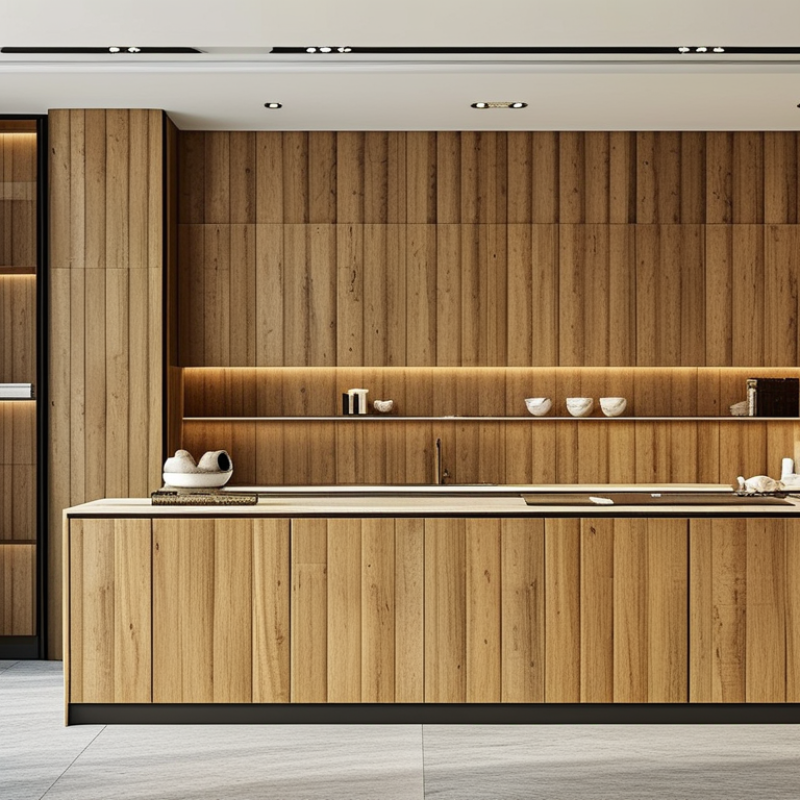
| Interior wall and ceiling panels | Applied as decorative wall cladding, feature walls, ceiling panels, reception areas, and room dividers. | Adds natural texture, warmth, and visual continuity to interior spaces. | Allow for expansion gaps and follow the panel manufacturer’s installation and finishing instructions. |
| Architectural millwork | Used for built-in cabinets, wall systems, columns, counters, trim elements, and custom interior fittings. | Supports coordinated designs across large and small wood surfaces. | Veneer grain direction, panel matching, and color variation should be planned before fabrication. |
| Doors and partitions | Used as decorative faces for interior doors, sliding doors, screens, and non-load-bearing partitions. | Creates a durable, wood-look finish for high-visibility interior elements. | Door and partition cores must be selected for the required weight, stiffness, hardware, and fire-performance specifications. |
| Retail, hospitality, and office interiors | Used for counters, display fixtures, conference-room walls, office storage, restaurant interiors, and hotel furniture. | Offers a refined natural finish suitable for customer-facing environments. | High-traffic areas may need a protective finish with suitable resistance to abrasion, stains, and cleaning products. |
| Residential interiors | Commonly used for kitchens, living-room cabinetry, bedrooms, home offices, media units, and decorative storage. | Allows homeowners to use natural wood surfaces with controlled appearance and efficient fabrication. | Panels exposed to water or steam require a moisture-appropriate substrate, edge treatment, adhesive, and finish. |
| Structural applications | Structural laminated veneer products can be used in beams, headers, framing members, and engineered wood components when specifically rated for those purposes. | Engineered veneer construction can provide predictable strength and dimensional performance. | Decorative veneer-faced panels should not be treated as structural products unless they carry the required structural classification and documentation. |
| Typical thickness range | Decorative veneer-faced panels are commonly available in approximately 6–25 mm thicknesses, while structural products may be thicker or produced to project specifications. | Different thicknesses support applications ranging from lightweight cladding to furniture and cabinetry. | Actual availability varies by substrate, construction method, panel size, and local standards. |
| Surface finish | Panels may be supplied unfinished or coated with clear lacquer, oil, varnish, paint, or another specified finish. | Finishing can enhance color, grain visibility, stain resistance, and cleanability. | Finish samples should be reviewed because veneer color and grain naturally vary between sheets. |
| Dimensional stability | Cross-layer construction and a stable substrate generally reduce movement compared with a single solid-wood board, but wood-based panels still respond to humidity. | Helps reduce warping and supports larger, flatter interior surfaces. | Store panels flat in a dry, conditioned space and allow appropriate acclimatization before installation. |
| Moisture suitability | Standard interior panels are generally intended for dry or controlled indoor environments; moisture-resistant versions are available for specific conditions. | Selecting the correct grade improves service life in kitchens, utility areas, and other demanding spaces. | No wood veneer panel should be assumed suitable for exterior or continuously wet use without documented approval. |
| Environmental considerations | Veneer uses a thin layer of wood over a panel core, and many products are available with recycled-content cores or certified wood sources. | Can reduce the amount of solid timber needed for a broad visible surface. | Review wood-source documentation, formaldehyde-emission information, recyclability, and the adhesive system for the specific product. |
Selection note: The appropriate panel depends on the intended use, core construction, moisture exposure, required strength, surface finish, fire requirements, and installation method.
Laminated wood veneer panels begin with carefully selected timber. Workers inspect each log for grain direction, knots, moisture, and visible defects. The log is peeled or sliced into thin veneer sheets. Slicing creates different grain patterns and affects the panel’s final appearance. Each sheet is then dried under controlled conditions. Excess moisture can cause warping, swelling, or weak bonding later.
After drying, technicians grade the veneers and arrange them in matching layers. Some panels use parallel grain, while others use cross-oriented sheets for greater stability. A measured adhesive layer is applied between the veneers. The stack enters a hot or cold press, where pressure holds the layers together while the adhesive cures. Temperature, pressing time, and moisture must remain consistent. Small process changes can affect flatness and strength.
The pressed panel is trimmed, sanded, and checked for gaps, surface damage, and thickness accuracy. Experienced inspectors also compare the grain pattern across the face. A slight color mismatch may remain, especially with natural timber. That is not always a manufacturing failure, but it deserves honest evaluation. In practical use, these panels support cabinet doors, wall cladding, furniture surfaces, and interior partitions. Their performance depends on proper sealing, stable indoor conditions, and careful installation. Even a well-made panel can fail when exposed to constant moisture.
Laminated wood veneer panels are widely used for interior surfaces and furniture components. Their thin wood layers create a consistent appearance while using material efficiently. In homes, they cover feature walls, ceiling sections, doors, room dividers, and built-in storage. The visible grain can make a hallway feel warmer without adding heavy solid timber.
Furniture makers often use these panels for cabinet doors, wardrobes, desks, shelving, and drawer fronts. A stable core helps reduce movement, especially when panels are properly supported. In practice, careful edge treatment matters. Exposed edges can reveal the construction, so matching veneer strips or solid edging often improves the finished appearance. Grain direction also affects the design. A vertical pattern can make a cabinet look taller, while a continuous horizontal pattern may suit a long sideboard.
Tips: Check the panel’s moisture rating before using it in kitchens or bathrooms. Keep the surface dry during installation. Use clean cutting tools to reduce chipped edges. Leave room for expansion where the panel meets a wall. Small errors show clearly on large surfaces. No panel is flawless, and natural grain differences may appear between pieces. That variation can be attractive, but it should be planned rather than discovered after installation.
Laminated wood veneer panels combine thin wood layers into stable, useful surfaces. Their role extends beyond appearance. In structural design, laminated veneer lumber can form beams, headers, columns, and long-span floor members. The U.S. Forest Products Laboratory’s Wood Handbook, 2021, explains that engineered wood improves consistency by distributing natural defects across multiple veneers. That consistency supports predictable load design.
The details matter. Veneer grain usually runs in the load-bearing direction, helping panels resist bending and compression. Structural engineers still check span, moisture, connection strength, and fire performance. The American Wood Council’s National Design Specification provides recognized design values for wood members and connections. A panel may look strong. It still needs calculation. Poor detailing can cause swelling near wet rooms, especially when edges remain unsealed.
Decorative design uses the same layered logic differently. Face veneers create warm wall panels, cabinet doors, ceilings, and furniture surfaces. Core layers provide thickness and stability, while the visible grain controls the room’s visual rhythm. FAO’s Global Forest Resources Assessment 2020 reports that forests cover about 31% of global land area. Efficient veneer use can help reduce reliance on wide, clear boards, although sourcing and certification remain important questions. Designers should inspect veneer matching, repair small surface flaws, and confirm formaldehyde emissions before specifying panels. Some imperfections add character. Others reveal rushed manufacturing.
Laminated wood veneer panels are used for wall cladding, ceilings, doors, furniture, cabinetry, and lightweight partitions. Their layered construction can provide visual warmth with more dimensional stability than a solid board. Selection, however, should begin with the environment, not the appearance. A bright showroom is not a moisture test.
Moisture remains a decisive factor. The USDA Forest Products Laboratory’s Wood Handbook reports that wood reaches approximately 12% moisture content at 20°C and 65% relative humidity. Panels installed near kitchens, bathrooms, or exterior walls therefore need suitable cores, edge sealing, and adhesive systems. Thickness also matters. A thin decorative panel may suit a ceiling, while a thicker structural panel handles greater loads and resists bending more effectively. These choices are easy to underestimate.
Veneer quality, grain direction, bonding pressure, surface coating, fire classification, and formaldehyde emissions all influence performance. The Wood Handbook notes that wood properties vary with species, density, grain, and moisture content, so visual matching alone is unreliable. Environmental data deserves attention too. The FAO Global Forest Resources Assessment 2020 recorded about 4.06 billion hectares of global forest area, yet responsible sourcing still depends on traceability and renewal practices. Life-cycle reports also show that transport, resin content, and service life can change a panel’s environmental profile. A low-impact claim may sound convincing, but the evidence should be checked. Real installations are less forgiving. Scratched edges, uneven substrates, and poor ventilation often expose weaknesses that product samples hide.
No account yet?
Create an Account