







What Is a Trash Can Manufacturer and How to Choose One?
Choosing a Trash Can MANUFACTURER is not merely a purchasing decision. It is a practical test of materials, durability, hygiene, and long-term responsibility. A bin stands beside a kitchen counter, office desk, loading dock, or hospital corridor. Its lid, wheels, hinges, and inner surface face repeated daily pressure.
The scale of waste makes this choice more important. The United Nations Environment Programme’s Global Waste Management Outlook 2024 estimates that municipal solid waste may rise from 2.1 billion tonnes in 2023 to 3.8 billion tonnes by 2050. The U.S. Environmental Protection Agency reported 292.4 million tons of municipal solid waste in 2018. Meanwhile, Grand View Research projects strong growth in smart waste management through 2030. These figures point toward better collection systems, but they also expose a weakness: a connected bin still fails if its body cracks or its sensor cannot survive moisture.
Circular-design authority William McDonough offers a useful principle: “Waste equals food.” A capable Trash Can MANUFACTURER should apply that idea through recyclable materials, replaceable parts, and realistic end-of-life planning. Look for documented resin grades, load testing, odor-control performance, warranty terms, and factory quality controls. Ask for evidence, not attractive catalog language.
The choice is rarely perfect. Stainless steel may last longer, yet it can cost more and show fingerprints. Recycled plastic can reduce virgin material use, but its quality varies. Buyers should compare actual operating conditions, not only unit prices. A reliable supplier explains those trade-offs clearly and accepts careful questions. That honesty matters.
What Is a Trash Can Manufacturer?
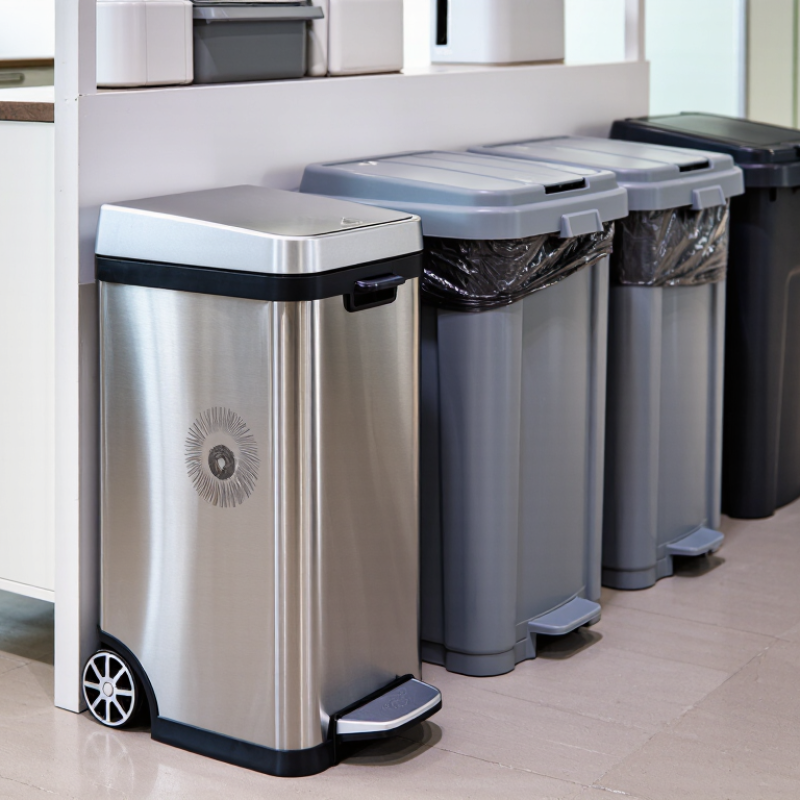
A trash can manufacturer is a company that designs, produces, and tests waste containers for homes, offices, public areas, and industrial spaces. Its work may include selecting stainless steel, plastic, aluminum, or recycled materials. It also handles cutting, molding, welding, surface finishing, lid fitting, and quality inspection. A professional manufacturer should understand capacity, odor control, fire resistance, durability, and cleaning needs. These details affect daily use more than appearance alone.
In practical purchasing, check whether the manufacturer can provide clear material specifications, product drawings, sample units, and inspection records. Ask how the factory tests hinges, pedals, wheels, coatings, and load strength. A dependable supplier should explain production times and packaging methods without vague promises. Consistent communication matters, especially when custom dimensions or colors are required. No factory is perfect. However, unclear answers and repeated sample defects deserve careful attention.
Tips: Compare at least three manufacturers. Request a physical sample before placing a large order. Inspect sharp edges, lid movement, base stability, and liner compatibility. Review the warranty and replacement process. A lower price may hide thinner material or weaker components. I would also check whether the manufacturer can maintain the same quality across repeat orders, because one excellent sample proves very little.
| Selection Dimension | Relevant Data | What to Check With the Manufacturer | Why It Matters |
|---|---|---|---|
| Manufacturer Role | A trash can manufacturer designs, produces, tests, and supplies waste containers or related components. | Confirm whether the supplier is an original manufacturer, contract producer, distributor, or a combination of these. | The business model affects customization, technical support, production control, and communication. |
| Common Product Materials | HDPE and PP are common plastics; stainless steel is widely used for durable indoor and commercial containers. | Request the material grade, recycled-content percentage if applicable, UV resistance, and chemical-resistance information. | Material selection influences impact resistance, corrosion resistance, appearance, weight, and service life. |
| Typical Capacity Range | Household and office containers commonly range from about 10 to 60 L; larger mobile containers commonly range from about 120 to 1,100 L. | Check the nominal capacity, usable capacity, external dimensions, lid clearance, and available liner size. | Capacity must match waste volume, collection frequency, available floor space, and handling requirements. |
| Capacity Conversion | 10 L ≈ 2.64 US gal; 30 L ≈ 7.93 US gal; 60 L ≈ 15.85 US gal; 120 L ≈ 31.70 US gal; 240 L ≈ 63.40 US gal. | Confirm whether product specifications use litres, US gallons, imperial gallons, or another measurement system. | Clear unit conversion helps prevent ordering errors across international markets. |
| Lid and Opening Design | Common options include swing lids, hinged lids, removable lids, push openings, flaps, and hands-free pedal lids. | Evaluate opening size, lid movement, odour control, noise level, hinge strength, and compatibility with liners. | The lid design affects hygiene, user convenience, safety, and contamination control. |
| Mobility Features | Mobile models may use two or four wheels, depending on capacity and handling needs. | Check wheel diameter, wheel material, load rating, turning clearance, handle design, and brake availability. | Suitable mobility features reduce handling effort and improve stability during movement. |
| Product Standards | EN 840 is associated with mobile waste containers and their dimensions, performance, and testing requirements. | Ask which standard applies to the product and request the relevant test reports or declaration of conformity. | Standards provide a structured basis for evaluating safety, compatibility, dimensions, and performance. |
| Quality Management | ISO 9001 is an internationally recognized quality management system standard. | Verify the certificate scope, certification body, validity period, and whether the production site is covered. | A valid quality system can support consistent processes, traceability, corrective action, and inspection control. |
| Environmental Management | ISO 14001 is an internationally recognized environmental management system standard. | Check whether environmental certification covers the manufacturing facility and ask about waste, energy, and emissions controls. | Environmental management information helps assess the supplier’s production practices and sustainability controls. |
| Customization Options | Possible options include color, capacity, lid style, labels, openings, pedal systems, logos, and packaging. | Request drawings, color references, tooling requirements, sample approval procedures, and minimum order quantities. | Clear customization terms reduce design risk, approval delays, and unexpected tooling costs. |
| Product Testing | Relevant checks may include impact resistance, load performance, wheel durability, lid-cycle testing, leakage, and dimensional inspection. | Ask for the test method, test conditions, sample size, acceptance criteria, and test report date. | Documented testing provides stronger evidence than product descriptions alone. |
| Production Traceability | Useful traceability records may include batch numbers, production dates, raw-material records, and inspection results. | Confirm how defects are recorded, how batches are identified, and how corrective actions are communicated. | Traceability makes quality investigations and replacement decisions faster and more reliable. |
| Order and Delivery Terms | Lead time, minimum order quantity, packaging method, shipping terms, and payment terms vary by product and supplier. | Obtain a written quotation showing specifications, quantity, tooling, packaging, lead time, inspection terms, and delivery conditions. | A complete quotation allows accurate total-cost and supply-risk comparisons. |
| After-Sales Support | Support may include spare parts, replacement lids or wheels, usage instructions, warranty terms, and complaint handling. | Review warranty duration, exclusions, response time, spare-parts availability, and the process for handling defective goods. | Reliable support can reduce downtime and extend the useful life of the containers. |
| Best Supplier Choice | The strongest option balances product fit, verified quality, total cost, delivery reliability, compliance, and service. | Compare at least two or three written offers using the same specification and evaluation criteria. | A structured comparison prevents price-only decisions and improves purchasing consistency. |