7 Tips to Choose the Best Conical Burr Hand Grinder
Choosing a hand grinder can feel simple until you compare burr shapes, adjustment systems, and build quality. A Conical Burr Hand Grinder is often valued for its compact design and controlled grinding, but the label alone does not guarantee a good cup. The right model should suit your brewing routine, your hands, and the amount of coffee you prepare. Small details matter. A loose handle or awkward adjustment ring can turn a quiet morning into a frustrating one.
These seven tips focus on practical features you can inspect before buying: grind consistency, adjustment range, burr material, capacity, portability, cleaning, and overall ease of use. Product specifications can help, but they do not tell the whole story. Look for clear information about burr size, replacement parts, and how settings change between fine espresso grinds and coarser brewing methods. Then compare those details with your own needs. A lightweight grinder may travel well, while a sturdier model may feel more stable on the counter. Neither choice is automatically better.
There is no perfect grinder for everyone. Even careful research cannot predict exactly how a handle will feel in your hand. Use these tips as a checklist, not a promise of flawless performance. A little uncertainty is normal. The goal is to find a dependable grinder that makes daily coffee easier, produces a grind suited to your brewer, and remains comfortable to use over time.
Define the Key Features of a Conical Burr Hand Grinder
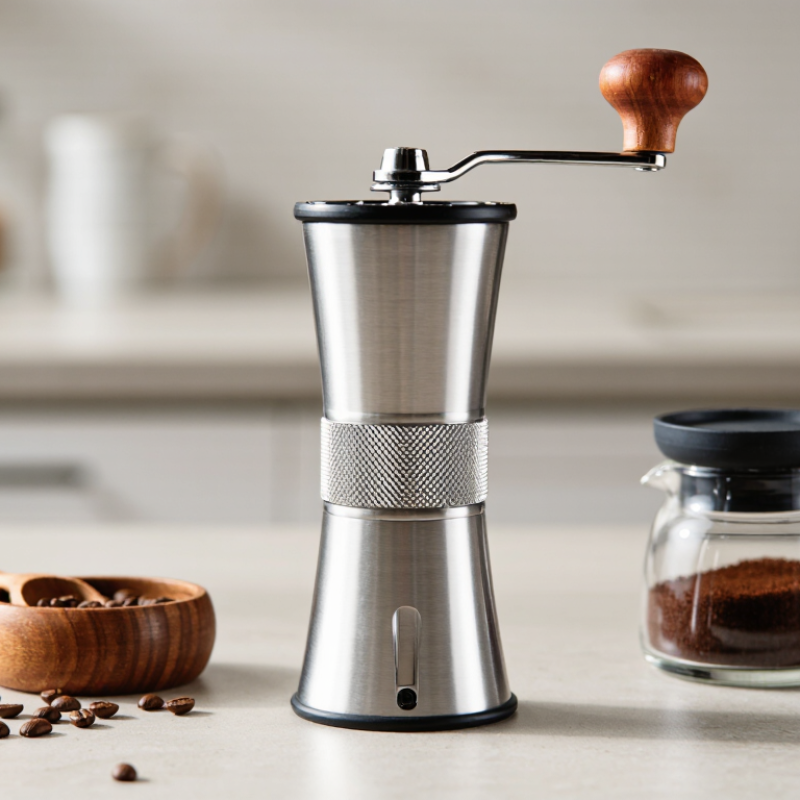
A conical burr hand grinder uses two cone-shaped cutting surfaces to break coffee beans into smaller particles. The distance between the burrs controls grind size, so a clear adjustment system matters. Look for steps that click firmly into place and are easy to count. Tiny markings can be difficult to read in a dim kitchen.
Burr material and alignment affect consistency. Well-aligned burrs produce fewer very fine particles alongside larger chunks, though no hand grinder eliminates variation completely. Check whether the burr assembly feels stable when you turn the handle. A little wobble is worth noticing. It may be hard to judge from product photos alone.
Consider the handle, grip, and bean capacity together. A longer handle can make grinding easier, but it may feel awkward in a small travel kit. Textured surfaces help when your hands are damp. The catch cup should attach securely and empty without scattering grounds across the counter. Small details matter.
Cleaning access is another key feature. A grinder that opens without special tools is easier to maintain, but frequent disassembly can also wear on patience. Check whether the manufacturer provides clear care instructions. Hand grinding takes effort, especially for very fine settings. That trade-off is real. A practical choice balances adjustment range, comfort, build quality, and the amount of coffee you usually prepare.
Compare Burr Materials, Sizes, and Grinding Performance
Burr material affects durability, heat resistance, and maintenance, but it does not determine cup quality alone. Stainless steel burrs are tough and resist corrosion, making them practical for frequent use. Ceramic burrs stay sharp for a long time, though a hard drop can chip them. Both can grind well when properly aligned. Feel the handle and check for wobble; uneven burr movement can create inconsistent grounds.
Burr size matters, but bigger is not automatically better. Larger burrs may grind faster because they cut more coffee with each turn. In a hand grinder, however, burr geometry and alignment often matter as much as diameter. Look for clear adjustment steps, then test a few settings with the same beans. Fine grounds should feel even between your fingers, not gritty with scattered large pieces. For pour-over, a steady, fairly uniform grind helps water flow predictably. Espresso needs finer adjustment and more effort. It can be tiring.
Grinding performance also depends on bean freshness, roast level, and the grinder’s adjustment mechanism. Dark beans may feel easier to crush but can leave oily residue. Clean the burr chamber regularly with a dry brush, and avoid washing parts unless the maker permits it. I have found that tiny adjustment changes can produce surprisingly different brews; sometimes I still misjudge the setting. Keep notes, compare the cup, and choose the material and size that suit your routine.
7 Tips to Choose the Best Conical Burr Hand Grinder — Compare Burr Materials, Sizes, and Grinding Performance | Tip | What to Compare | How It Affects Grinding | What to Look For |
| 1 | Burr material | Steel and ceramic burrs can both grind coffee effectively. Steel burrs are generally less brittle; ceramic is hard but can chip if struck or handled roughly. | Choose a material with clear care and replacement guidance. Material alone does not determine cup quality. |
| 2 | Burr diameter | Larger burrs can process beans more quickly when other design factors are comparable. Diameter by itself does not guarantee a more consistent grind. | Compare stated burr diameter alongside grind consistency, handle effort, and the amount of coffee you typically prepare. |
| 3 | Adjustment range | Espresso generally calls for finer settings than French press. A grinder with a broad, usable adjustment range can accommodate more brew methods. | Check that it offers fine steps for espresso-style brewing and coarser settings for immersion methods, if you use both. |
| 4 | Adjustment precision | Small, repeatable setting changes make it easier to fine-tune grind size. The number of clicks per rotation is not directly comparable across different designs. | Look for secure settings that are easy to identify and return to, especially when switching between brew methods. |
| 5 | Grind consistency | More uniform grounds can support more even extraction. Results also depend on burr geometry, alignment, bean type, and the chosen setting. | Read independent testing for the brewing method you use, or check whether the grinder produces a consistent grind at your preferred setting. |
| 6 | Crank effort and stability | Handle length, bearing design, and how securely the burrs are supported affect the effort and steadiness of manual grinding. | Choose a comfortable handle and a stable body. If possible, try the grinder with beans rather than judging it by appearance alone. |
| 7 | Capacity and upkeep | A larger bean chamber can reduce the need for multiple batches, while removable parts can make cleaning and maintenance easier. | Match capacity to your usual dose, and check whether the burrs can be accessed for cleaning without losing the adjustment setting. |
Evaluate Grind Settings for Different Brewing Methods
A hand grinder should offer useful steps, not merely a long list of settings. Check how finely its burrs adjust and whether clicks produce noticeable changes in the cup. For pour-over, a medium grind should feel like coarse sand; French press usually needs a coarser, more even texture. Espresso demands much finer adjustment, where a small turn can change flow time. That range matters.
The Specialty Coffee Association’s Brewing Control Chart places many brewed coffees in an extraction-yield range of 18–22%, with a typical beverage-strength range of 1.15–1.35% total dissolved solids. These figures are reference points, not guarantees for every brew method. Use them alongside taste: sourness may suggest under-extraction, while harsh bitterness can signal over-extraction. A scale and timer help separate grind problems from inconsistent pouring.
Test one setting at a time. Keep the dose and water temperature steady, then note the grinder’s click setting and brew time. For example, if a pour-over drains too quickly and tastes thin, try a slightly finer setting. Change too much at once, and the result gets muddy. I still find that burr alignment and bean age complicate neat rules; a grinder’s marked settings are only a starting map.
Match the Grinder to Your Budget and Daily Coffee Routine
A hand grinder should fit your real coffee routine, not an imagined one. Think about how many cups you make, how often you travel, and what you can comfortably spend. A budget model can be a sensible choice for one morning cup, especially if its handle turns smoothly and its settings are easy to adjust. If you brew several cups daily, sturdier construction and consistent adjustment may matter more than a lower price. Hold it, if possible. A grinder that feels awkward may stay in the cupboard.
Tip: Match capacity to your usual batch. Grinding a small amount for one mug takes little effort; preparing coffee for a group can make a tiny hopper feel tedious. Conical burr grinders offer adjustable particle sizes, but fine settings may require more turns. If you mostly make pour-over coffee, check that the adjustment can produce an even, medium grind. For occasional espresso-style brewing, confirm the grinder supports finer settings before buying.
Tip: Consider the daily details. A removable handle, simple cleaning, and a stable grip can make a modest grinder pleasant to use. Read specifications carefully, but treat exact grind claims with some caution; brewing results also depend on beans and technique. I once underestimated how much a narrow catch cup could scatter grounds. It was annoying, and I still forget to brush it clean sometimes. Choose a grinder you will actually maintain.
7 Tips to Choose the Best Conical Burr Hand Grinder
Match your grinder budget and daily coffee routine to how much coffee you actually brew.
How to use this chart: The estimates assume 15 g of coffee beans per serving and 30 brewing days per month. A one-cup routine uses about 0.45 kg monthly; four servings use about 1.8 kg. Consider your usual batch size and frequency when weighing grinder capacity, adjustment convenience, and budget.