




Best Private Label Bedding Supplier in China?
Choosing the best supplier for Private Label Bedding in China takes more than comparing unit prices. Buyers need to assess fabric quality, construction, customization, communication, and production consistency. A smooth cotton duvet cover may look convincing in a sample, yet shrinkage or uneven stitching can appear after washing. Small details matter.
The scale of the textile supply chain makes material questions increasingly important. Textile Exchange’s Materials Market Report 2024 estimates that global fiber production reached 124 million tonnes in 2023 and could rise to 160 million tonnes by 2030. This is not a bedding-only forecast, but it highlights why buyers should ask suppliers for clear fiber specifications and supporting documentation. Ask for fabric composition, colorfastness and shrinkage test results, and details about any claimed certifications. Verify each document with its issuing organization when possible.
Look beyond the showroom sample. Request a pre-production sample, confirm minimum order quantities, and agree on inspection criteria before bulk manufacturing. Check whether the factory can maintain the same fabric, stitching, labels, and packaging across repeat orders. Responsiveness matters, too. A supplier that answers difficult questions clearly is often more useful than one offering the lowest quote. Still, no checklist guarantees a perfect partnership. I would treat initial claims as unverified until samples, records, and production performance support them. The right partner is not simply the cheapest. It is the one whose capabilities match your product, timeline, and quality expectations.
What Private Label Bedding Means and How It Differs from White Label
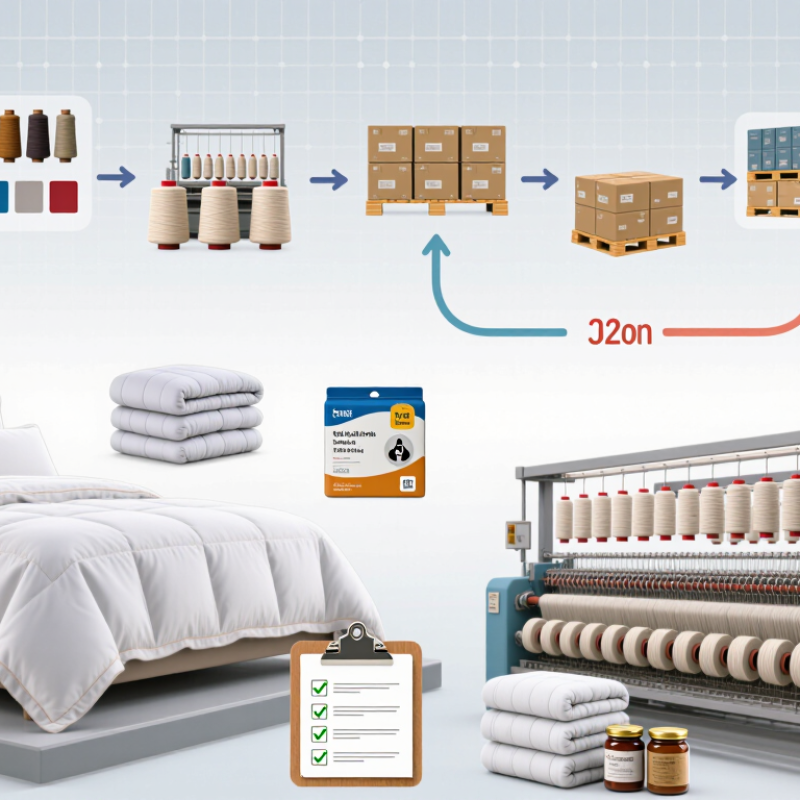
Private label bedding means products are developed to match a retailer’s own specifications. The buyer may choose fabric, colors, dimensions, labels, packaging, and finishing details. A supplier then produces those items under the buyer’s brand. This can include a custom weave or a particular fitted-sheet pocket depth. It usually requires more sampling and product checks.
White label bedding typically starts with an existing, ready-made design. A supplier offers it to multiple buyers, who add their own labels or packaging. Changes are often limited. That distinction matters. Private label offers more control, but may need higher minimum orders and longer development. White label can be faster, though its fabric and construction options may be narrower. According to Grand View Research, the global bed linen market was valued at USD 22.3 billion in 2023, with projected growth of 7.4% annually from 2024 to 2030. More choice can help a product stand out, but only if quality is consistent.
Tip: Request a sample and check it after washing. Measure shrinkage, inspect seams, and confirm fabric composition and weight. Ask for written tolerances and production timelines. A sample can look excellent; bulk production may still vary. Verify the details before placing a large order.
| Comparison Dimension | Private Label Bedding | White Label Bedding |
|---|---|---|
| Basic Meaning | Bedding made for a buyer and sold under that buyer’s own label, often using specifications or design choices agreed with the manufacturer. | A supplier’s existing, generally standardized bedding product that multiple buyers may sell under their own labels. |
| Product Development | The buyer can request product-specific changes, such as fabric, dimensions, colors, construction, or packaging, subject to supplier capability and agreement. | The buyer typically selects from products the supplier already offers, with fewer changes to the underlying product. |
| Typical Bedding Range | May include customized sheet sets, duvet covers, pillowcases, quilts, comforters, or mattress protectors. | Usually selected from the supplier’s existing bedding range, such as standard sheet sets, duvet covers, or pillowcases. |
| Specifications to Confirm | Confirm fiber content, fabric construction, finished dimensions, color references, stitching, closures, filling details where applicable, and tolerances in the purchase specification. | Confirm the same product details, even when choosing an existing item; catalog descriptions alone may not cover every specification. |
| Label and Packaging | Buyer-specific labels and packaging can be requested. Approve artwork, wording, care information, and packaging samples before production. | Private labels or packaging may also be available, but customization is often limited to the supplier’s available options. |
| Exclusivity | Customization does not automatically mean exclusive production. Any exclusivity, ownership of designs, or limits on resale should be clearly agreed in writing. | The same or similar standard product may be offered to other buyers unless a written agreement states otherwise. |
| Order Planning | New specifications, sampling, material sourcing, or custom packaging can add approval steps. Confirm sample timing, production timing, and minimum order quantity directly with the supplier. | Using an existing product may reduce development steps, but availability, order quantity, and production timing still need to be confirmed. |
| Best Suited To | Buyers seeking differentiated products, a defined specification, or more control over product details. | Buyers seeking a quicker route to market with a product selected from an existing range and limited product changes. |
| Supplier Checks | Request a sample made to the agreed specification, verify the supplier’s production capabilities, and document approved materials and quality requirements. | Request a sample of the selected catalog item and confirm that bulk production will match the approved sample and written specifications. |
| Compliance and Claims | Agree on applicable destination-market requirements and substantiate claims such as fiber content, safety, or environmental attributes with appropriate documentation. | Apply the same checks; an existing product listing does not by itself establish compliance or substantiate product claims. |
| Note: “Private label” and “white label” are not used identically by every supplier. Confirm the exact product scope, customization, labeling, quality requirements, exclusivity, and commercial terms in writing before placing an order. | ||